 THE ULTIMATE BIDDER
THE ULTIMATE BIDDER
THE ULTIMATE BIDDER
3DTSI's in-house AI estimating platform. It scouts the market, reads the entire bid package, prices every line from our own awarded-job history, checks its own work, and produces the submission proposal — for two to three dollars of measured AI per complete bid.
Every dollar of revenue and every point of margin starts at the estimate. Yet estimating at almost every contractor in our industry still looks like this:
Someone logs into a dozen bid boards every morning and eyeballs what's worth chasing. Good jobs are missed because nobody had time to look.
It can run past 150 sheets, so it doesn't get read. That's exactly where the warranty traps, sole-source locks, and prevailing-wage triggers hide.
Most estimators price from a national cost book — ignoring the most valuable data the company owns: what it actually paid and won with on its own jobs.
A complex bid is a multi-day effort, and one missed scope line or one phantom row can swing it by tens of thousands of dollars.
The whole estimating workflow runs as a single pipeline. Scroll to walk it stage by stage.
Watches 70 bid boards, refreshes every 15 minutes, ranks every job 0–100 against our profile.
"Should we even bid this?" A structured Go / No-Go — before anyone opens a PDF.
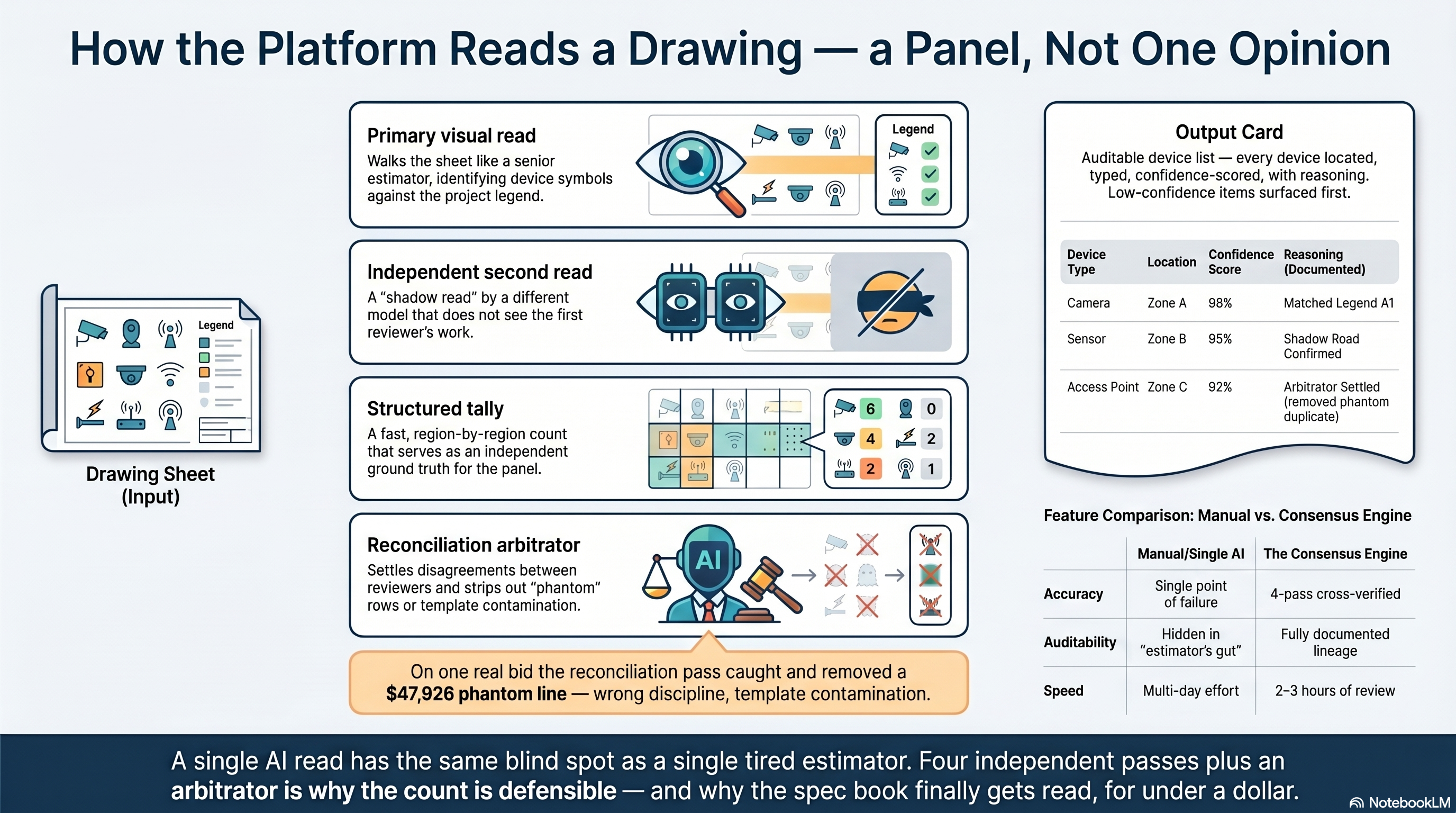
Two dozen+ AI reviewers. Every drawing gets a 4-pass consensus read. The full spec book — read, not skipped.
Every line priced from our own awarded-job data. Every number carries its source.
A self-QA gate. Hundreds of uncertainties collapse to a 15–25 item ranked focus list.
Tiered Excel + Word on letterhead + combined PDF, formatted to the agency's bid form.
It does not replace the estimator. It removes the clerical work and elevates the judgment work.
A single AI read has the same blind spot as a single tired estimator. So every drawing sheet gets a four-pass consensus read.
Walks the sheet like an estimator — locates and types every device.
A different reviewer, working blind to the first. The second set of eyes.
Counts region by region — an independent ground-truth count.
Settles disagreements and strips phantom detections the others didn't confirm.
A team of named specialists who hand audited work to each other — modeled on how a real estimating department actually operates.
Walks every drawing with AI vision — every device located, typed, confidence-scored and auditable.
Reads the whole spec book hunting the clauses that kill margin — warranties, sole-source locks, lead-time traps.
Prices every line through a disciplined cascade — and escalates to a human rather than guess.
Final review against a readiness checklist. Blockers stop the bid from going out the door.
Parses vendor quotes, matches each line to the bid, flags the outliers.
The plain-English summary of the opportunity, with citations back to the source pages.
They never call each other directly — each one writes its audited work down and the next picks it up. Nothing is lost. The bid is fully auditable. The department can grow.
The platform doesn't "ask the AI what it costs." It runs a strict, ordered cascade and uses the best real source — falling back only when it has to.
An automated scout watches the market around the clock and answers "should we bid this?" for about a penny — upstream of any estimator time.
When deciding whether to pursue a bid costs a penny instead of an estimator-afternoon, the company can seriously evaluate every opportunity in the funnel — not just the ones it had time for. And every pursued / won / lost outcome is recorded from day one, building a proprietary win-prediction asset over time.
Outcomes from actual bids run through the live platform — not demonstrations.
The value shows up most clearly in the expensive mistakes it prevents — not just in time saved.
Cost scales with bids pursued — not headcount, not seats. The opposite of the usual software cost curve. Move the slider.
A measured platform is more credible than a polished one. These stay on the page on purpose.
On one Fire Alarm bid the pricing agent resolved 0 of 10 gaps — because it correctly escalated to a human instead of fabricating prices. The fix is a data-import sprint, not an engineering rebuild.
Several private bid-board connections are built but disabled, pending access approval per source. Coverage expands as access is granted.
Complex bids still need 2–3 hours of estimator review. The honest claim is multi-day → a few hours, not work → zero.
It's deep on 3DTSI's disciplines by design — that focus is why it understands prevailing wage and our spec structure. Adjacent trades are out of scope today.
That a system knows when not to guess — and tells you exactly which data to go get next — is the behavior you want in something you'll stake real bids on.
Watch it, listen on the drive to the meeting, or read the deep analysis. Identical numbers across every format.
The full strategic thesis — the leverage gap, the multi-agent consensus model, the data moat, the unit economics.
Download ↓The hardest questions an investor can ask — "is this just ChatGPT?", "what's the moat?", "what did 0/10 mean?" — answered straight.
Download ↓Every term — bill of materials, prevailing wage, consensus read, the cascade — in one plain sentence each.
Download ↓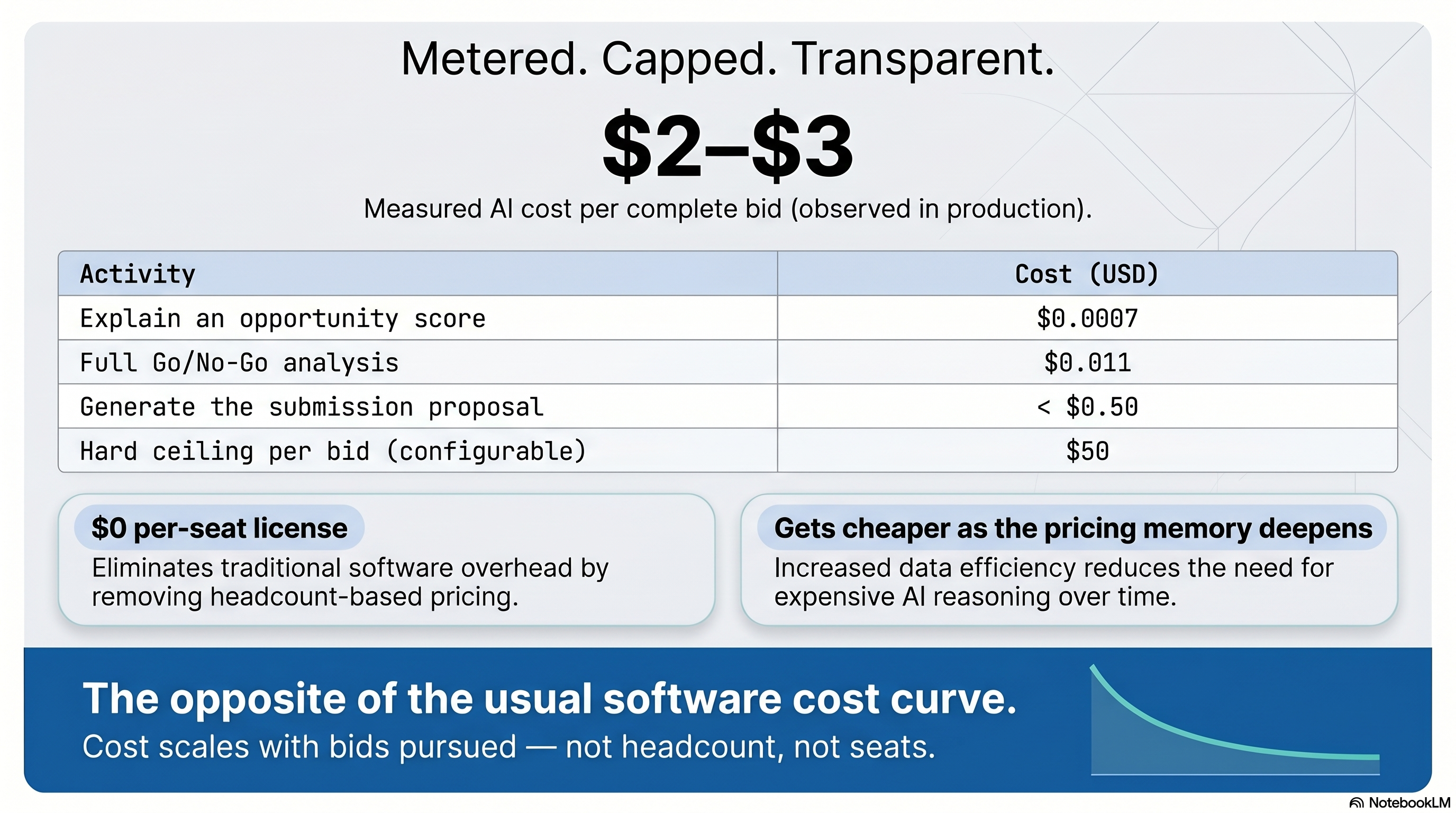
A multi-day estimating process is becoming a multi-hour one — on a platform that already works, runs on our own proprietary pricing memory, and gets smarter and cheaper with every bid it touches.